
Self Parenting Ourselves: Healing the Inner Child Through Codependency Recovery
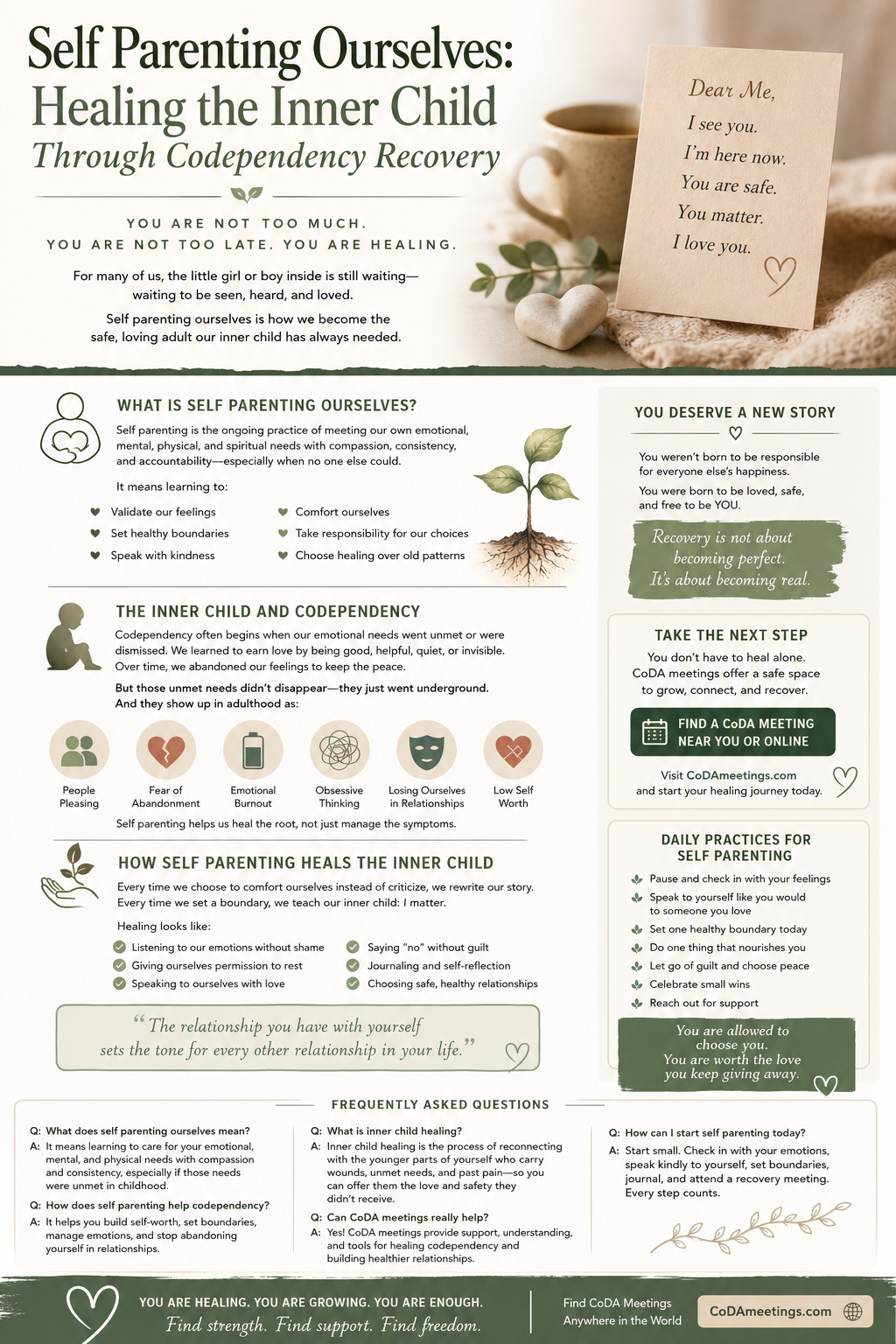
Self Parenting Ourselves: Healing the Inner Child Through Codependency Recovery
By CoDAmeetings.com
Somewhere along the way, many of us became adults without ever truly feeling emotionally safe.
We learned how to survive before we ever learned how to soothe ourselves. We became caretakers before we learned how to care for our own hearts. We learned how to read the moods of others, anticipate rejection, avoid conflict, over-explain ourselves, and earn love through sacrifice.
Many of us became experts at rescuing everyone except ourselves.
Behind the smiles, achievements, relationships, perfectionism, overthinking, and people-pleasing behaviors often lives a younger version of ourselves quietly asking:
“Will someone finally choose me too?”
For many recovering from codependency, the journey of healing begins when we stop searching outside ourselves for the love, safety, approval, and nurturing we never fully received.
This is where the powerful practice of self parenting ourselves begins.
Self-parenting is the process of becoming the loving, emotionally available, compassionate adult that our inner child has always needed. It is learning how to sit beside our pain instead of running from it. It is learning how to comfort ourselves instead of criticizing ourselves. It is learning how to stop abandoning ourselves in order to keep others comfortable.
And for many people, this changes everything.
The Invisible Wounds We Carry
Not all childhood wounds leave bruises you can see.
Some wounds sound like:
- “Don’t be so sensitive.”
- “Stop crying.”
- “You’re too emotional.”
- “Just keep the peace.”
- “Make everyone happy.”
- “Your needs are too much.”
Over time, many of us learned to disconnect from ourselves in order to stay connected to others.
We learned that love could disappear if we upset someone. We learned that boundaries created guilt. We learned that saying “no” risked rejection. We learned to become who others needed us to be while slowly forgetting who we truly were.
As adults, these emotional survival patterns can quietly evolve into:
- Codependency
- Fear of abandonment
- People pleasing
- Emotional burnout
- Relationship anxiety
- Over-giving
- Perfectionism
- Loss of identity
Many people living with codependent patterns are not weak — they are emotionally exhausted from carrying wounds they were never taught how to heal.
What Does Self Parenting Ourselves Really Mean?
Self parenting ourselves means learning how to give ourselves the emotional support, compassion, guidance, safety, accountability, and care we may not have consistently received growing up.
It means becoming emotionally present with ourselves instead of emotionally abandoning ourselves.
It means asking:
- What do I truly need right now?
- Why do I ignore my own emotions?
- What part of me still feels unseen?
- How can I comfort myself instead of criticizing myself?
- What would love look like if I offered it to myself too?
For many people, this feels unfamiliar at first. Because many of us were taught how to care for everyone else while neglecting our own emotional world.
But healing begins the moment we stop treating ourselves like enemies.
The Inner Child Still Lives Within Us
Inside every adult exists younger emotional parts still carrying grief, fear, loneliness, shame, confusion, or abandonment.
The inner child is not weakness. The inner child is the emotional memory of every moment we felt unseen, unheard, rejected, unsafe, or emotionally alone.
And even years later, those unmet needs often continue speaking through our relationships.
Sometimes they appear as:
- Fear of being left
- Needing constant reassurance
- Difficulty trusting others
- Over-explaining ourselves
- Emotional reactivity
- Controlling behaviors
- Seeking validation externally
- Staying in unhealthy relationships
What many people call “neediness” is often unresolved emotional pain searching for safety.
This is why self parenting ourselves is so transformative.
For the first time, we stop waiting for someone else to rescue us emotionally. We begin learning how to emotionally show up for ourselves.
And slowly, the relationship we have with ourselves begins to change.
The inner critic softens. The nervous system calms. Boundaries become healthier. Relationships become clearer. And self-worth slowly begins growing from the inside out.
Healing is not about becoming perfect. Healing is about becoming emotionally honest.