
Trauma & Attachment Injury: Healing the Wounds Beneath Codependency
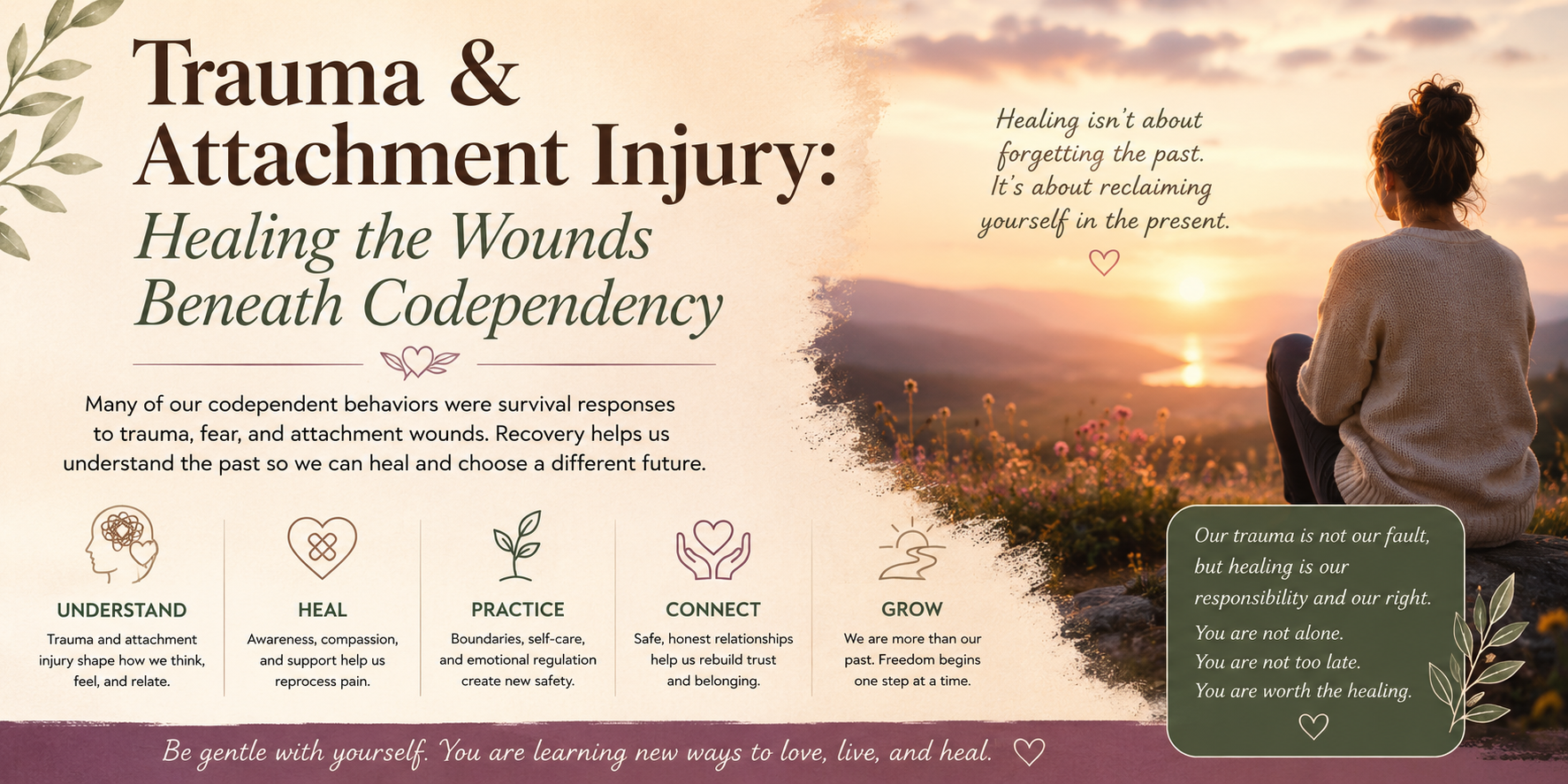
Understanding the Emotional Pain That Shapes Our Relationships, Behaviors, and Recovery
Many of us enter recovery believing our struggles began with unhealthy relationships, emotional dependency, people-pleasing, controlling behaviors, abandonment fears, or constantly losing ourselves in others. Yet beneath many of these patterns are deeper emotional wounds — trauma and attachment injuries that quietly shaped the way we learned to survive, connect, and protect ourselves.
Trauma is often described as the psychological and emotional impact of experiences that overwhelmed our ability to cope. Sometimes trauma comes from major life events, abuse, neglect, abandonment, instability, rejection, or frightening experiences. Other times it develops slowly over years of emotional inconsistency, criticism, fear, emotional neglect, or growing up in environments where we never truly felt emotionally safe.
For many of us, trauma was not always visible from the outside. It may have looked like becoming overly responsible, hyper-independent, emotionally guarded, perfectionistic, overly accommodating, or constantly focused on keeping peace in relationships. Many of us learned to survive by becoming caretakers, fixers, rescuers, performers, or protectors while quietly disconnecting from our own needs, emotions, and identities.
Attachment injury often develops when important emotional bonds — especially in childhood — feel unsafe, inconsistent, rejecting, controlling, or emotionally unavailable. These wounds can shape how we experience love, trust, safety, intimacy, and belonging throughout our lives. Many of us unknowingly carry fears of abandonment, rejection, conflict, loneliness, or not being enough.
As a result, we may spend years seeking validation outside ourselves, fearing disconnection, avoiding vulnerability, over-giving, suppressing our emotions, or believing our worth depends on being needed by others.
Many of the codependent patterns we struggle with today were not created because we were weak or broken. They were survival strategies developed during moments when we did not know how else to emotionally survive. We learned to scan for danger, avoid conflict, anticipate the needs of others, or abandon ourselves in order to preserve connection and emotional safety.
Even long after the original pain has passed, the nervous system can continue reacting as though danger is still present. Criticism may feel unbearable. Distance may feel like abandonment. Silence may feel threatening. Boundaries may trigger guilt or fear. Emotional intimacy may feel unsafe even when we deeply desire connection.
Many of us have lived with anxiety, shame, hypervigilance, emotional overwhelm, isolation, people-pleasing, emotional withdrawal, or difficulty trusting ourselves and others without fully understanding why. Trauma and attachment wounds often live beneath these reactions.
Recovery invites us to approach these patterns with compassion instead of judgment. Rather than asking, “What is wrong with me?” we slowly begin asking, “What happened to me?” and “What did I learn I needed to do in order to feel safe, loved, accepted, or worthy?”
Healing begins when we become willing to gently examine the ways we have coped with pain. Many of us used relationships, control, caretaking, addictions, avoidance, perfectionism, or emotional dependency as attempts to soothe wounds we did not yet know how to heal. While these behaviors may have once protected us, they often created more suffering over time.
Recovery is the process of learning new ways to respond to pain, fear, loneliness, shame, and emotional discomfort. We begin learning boundaries, self-awareness, emotional regulation, self-compassion, honesty, vulnerability, and healthy connection. We begin practicing staying connected to ourselves rather than abandoning ourselves for approval, validation, or love.
Beneath our survival patterns remains an authentic part of ourselves untouched by fear, shame, rejection, or codependency. Recovery helps us reconnect with that part slowly, honestly, and compassionately.
Healing does not happen all at once. It happens one aware moment, one boundary, one honest conversation, and one act of self-compassion at a time.
Our trauma is not our fault. But healing from it is both our responsibility and our right.